
Night walks in Manu National Park are essential for observing an astonishing variety of frogs. Often, we can find them wandering near our lodge, searching for prey. The diversity of frogs in Manu is incredible, with some species standing out for their vibrant colors, impressive sizes, and fascinating behaviors.
We present to you some of the most striking and even intimidating frogs in Manu National Park. However, spotting them requires a stroke of luck, as many of these species are rare and difficult to see.
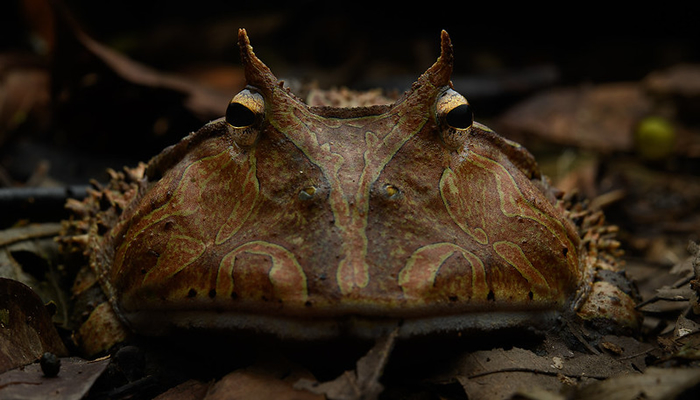
1. Surinam horned frog (Ceratophrys cornuta)
It is a terrestrial frog distinguished by its peculiar anatomy, as its mouth is notably larger in comparison to its body. Additionally, it has curious horn-like protrusions above its eyes. Females can reach up to 12 centimeters in length and weigh up to 130 grams, while males tend to be smaller. Their colors are highly varied, ranging from shades of green to brown, with dark patterns on their backs. These frogs are nocturnal, although it’s possible to see young specimens during the day.
2. Manu Poison Dart Frog (Epipedobates macero)
This frog is found in the jungles of southern and central Peru, inhabiting altitudes ranging from 150 to 1450 meters. It prefers to live in minimally disturbed forests near streams, where it can find its ideal environment. This frog is terrestrial and, unlike other species, is active during the day. The females lay their eggs on the ground, and once they hatch, it is the male’s responsibility to carry the tadpoles on his back to nearby streams, where they continue their development.

3. Nouns’ Glassfrog (Hyalinobatrachium spp.)
They are distinguished by their translucent skin, which allows you to see their internal organs, especially the heart and digestive system. They live in areas near rivers and streams in tropical rainforests, where they lay their eggs on leaves above the water. These frogs are nocturnal and small in size, measuring between 2 to 3 centimeters. Their unique and delicate appearance makes them fascinating species within the Amazon’s biodiversity.

4. Gunther’s banded tree frog (Hyla fasciatus)
It primarily inhabits tropical and subtropical forests at altitudes ranging from 700 to 1600 meters above sea level. Known for its nocturnal habits, it hides in dense vegetation or tree trunks during the day, while at night it emits a distinctive call to attract females during the mating season.

5. Tiger-legged monkey frog (Phyllomedusa hypochondrialis)
These frogs prefer to inhabit tropical and subtropical forests, both dry and wet, but they can also be found in seasonally flooded grasslands. Unlike other frogs that jump, they have the ability to walk slowly on trees, using their long, slender legs almost like monkeys. Additionally, they stand out as one of the few frog species that have opposable thumbs, allowing them to grip the thinnest branches with ease while moving through the vegetation.

6. Knudsen’s frog (Leptodactylus knudseni)
This frog belongs to the Leptodactylidae family and is found in various regions of South America, including countries like Bolivia, Brazil, Colombia, Ecuador, Peru, Suriname, and Venezuela. It is large, measuring up to 13 cm, and is characterized by its strong and muscular front legs. Its natural habitat includes tropical and subtropical lowlands. As a carnivorous species, its diet mainly consists of insects such as ants, flies, beetles, and crickets.

7. Beireis’ treefrog (Dendropsophus leucophyllatus)
This small frog is distinguished by its delicate body and smooth skin. It is primarily nocturnal, and its call can often be heard at dawn and dusk. Although solitary, these tree-dwelling frogs are highly territorial, using vocalizations to attract mates and defend their area. One of the most fascinating features of these frogs is their ability to change the color of their skin between day and night, providing them with excellent camouflage in the dense vegetation of the Amazon.

Manu National Park awaits you to discover its incredible biodiversity. A unique place where you can explore a vast number of species that inhabit its jungles, rivers, and mountains. Every corner of the park holds natural secrets waiting to be discovered by you.
